

Kelambakkam is a suburban and residential neighborhood in Chennai. Located in the southeastern part of the city along Old Mahabalipuram Road (OMR), Kelambakkam serves as the southern gateway to Chennai. Kelambakkam’s proximity to the Bay of Bengal, just 4.5 km away, makes it a prominent watershed zone with the presence of several water bodies. However, in recent years, Kelambakkam has witnessed a surge in urbanization. The region’s proximity to the IT corridors of OMR have made it a highly sought-after destination for residential and commercial development. The increased population density and industrial activities have put a strain on local water resources.
Spanning across 17.8 acres of picturesque land, the Milakathamman lake serves as a serene oasis nestled amidst the urban landscape of Kelambakkam. Its tranquil waters reflect the towering high-rise apartments to its north, contrasting with the natural expanse of land parcels towards the south.

As one ventures closer, the verdant landscape surrounding the lake comes into view, adorned with Acacia Auriculiformis and Eucalyptus trees. The lake holds paramount significance as a crucial component of a connected lake system, with its outlet merging with the inlet of the Vannan Eri, fostering a delicate balance within the local ecosystem.

However, the Milakathamman lake harbors a host of ecological challenges. The unchecked influx of gray water and effluents from the nearby apartments had tainted its pristine waters, introducing heavy metals such as phosphorus, nitrous, and sulfur into the delicate ecosystem. The consequence of this pollution is evident in the rampant eutrophication and excessive algal growth, fueled further by agricultural runoff seeping into the lake.


Adding to the ecological woes are the remnants of human activity, with residents in the vicinity contributing to plastic contamination through indiscriminate garbage dumping in the northeastern and southern fringes of the lake. Moreover, invasive weeds such as water hyacinth, Ipomea carnea, Prosopis juliflora, Bulrush, duckweeds, and alligator weeds have encroached upon the lake’s surface, forming a dense carpet that stifles native flora and fauna. In response to these challenges, restoration efforts have been made by E.F.I to restore the lake to its former glory. A multifaceted approach with activities involving de-silting, bund construction and strengthening, recharge pits and nesting islands are being carried out.
In response to these challenges, E.F.I has undertaken a series of restoration efforts to revive the Milakathamman Lake.


| Restoration Process | E.F.I’s Intervention |
| Deweeding | Prosopis juliflora, Lantana camara, water hyacinth, duckweed, alligator weed, Ipomoea carnea, Acacia auriculiformis, and eucalyptus across 11 acres were removed. |
| Desilting | Desilting for an average of 4 ft depth was carried out across 1.4 acres. |
| Bund Construction | The excessive silt from desilting was used to construct embankments. Offshore bund of 642 meters and foreshore bund of 468 meters were constructed. |
| Recharge Pits | 5 recharge pits were made to capture and filter runoff as well as to recharge groundwater. |
| Nesting Islands | 22 nesting islands were made to provide a safe haven for wildlife. These nesting islands play a crucial role in the reproductive success and survival of many species. |


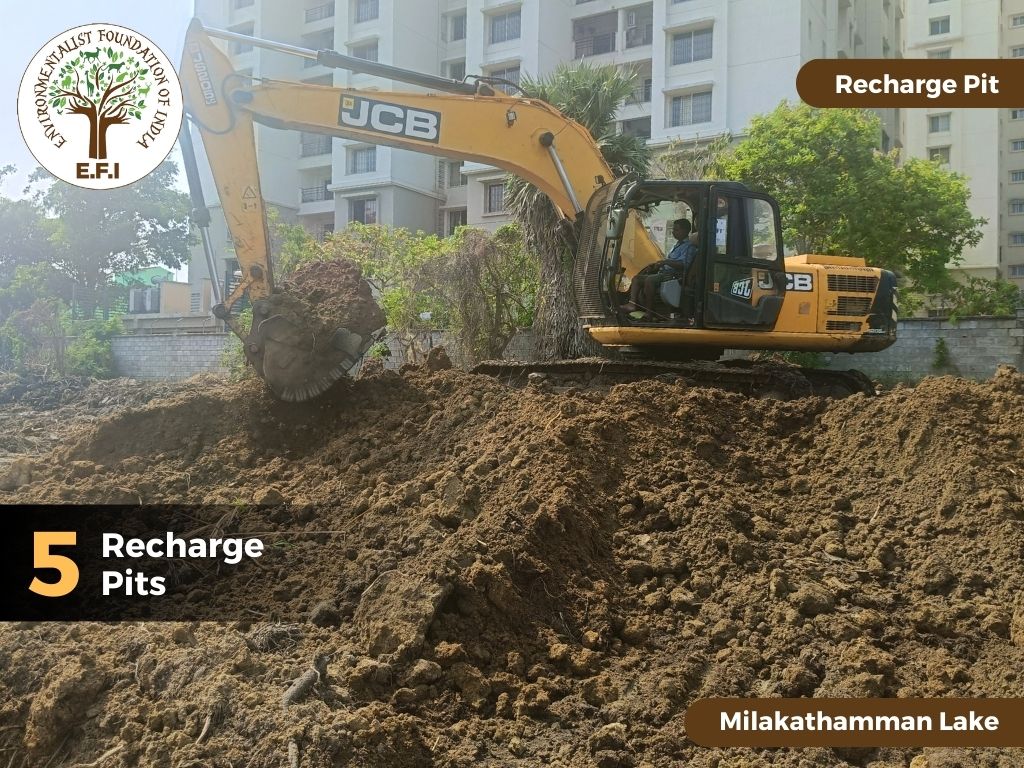


The Milakathamman Lake has been transformed into a thriving aquatic paradise, supporting a diverse ecosystem. The addition of 4 recharge pits and 22 nesting islands has significantly contributed to the overall health and balance of the ecosystem. The recharge pits help maintain the lake’s water levels and quality by capturing and filtering rainwater, improving drought resilience and water conservation.
The nesting islands provide breeding grounds for various bird species, supporting biodiversity. Together, these features contribute to a healthier ecosystem and offer valuable benefits to both wildlife and the local community.


Volunteer for India and her Environment with E.F.I